
What Can You Take From Early Season Flat Form?
The flat turf season is finally underway, although after starting off at Doncaster last Saturday, we have to wait until Musselburgh on Saturday for the next flat turf meeting - which always feels a liitle odd.
But, if you watched the racing over the weekend, you will already have felt that shift. The tempo is different, the races are faster, and more importantly, there is a little more uncertainty around what we are actually watching.
That is the key thing with this time of year. Horses are coming off winter breaks, some are having their first run back, others have been running over on the all-weather, and a few are arriving fully tuned up and ready to go.
The problem is, they do not all show that on paper. Early-season flat racing is one of the few times where the market is often working with incomplete information, and that is why you tend to see some surprising results.
One of the biggest mistakes people make at this stage is taking winter all-weather form too literally. It has its place and in my opinion, trainers have made the transition between the all weather and the turf a lot smoother. A few years back, horses all weather form could almost be ignored but now, perhaps also due to the newer 'sand' sufaces, the form can count - as can their fitness as importantly.
Of course many horses thrive on the all-weather through the winter and then struggle to reproduce it on grass, while others improve significantly once they get back onto a proper surface. You will often find that a horse finishing midfield on the all-weather can suddenly step forward on turf, especially if it is returning to its preferred conditions. This is key, don't just expect a horse to run well as it is fit from a few recent runs, check that it can do it on the turf first.
On the other hand, fitness shouldn't be under estimated. At this time of year, a horse that is fully wound up can beat a better horse that needs the run. Trainers know this, and some yards are far more likely to have their horses ready early than others. Historically, certain trainers tend to hit the ground running in the first few weeks of the turf season, while others build gradually into it. That is something worth paying attention to, because it is not always obvious from the bare form.
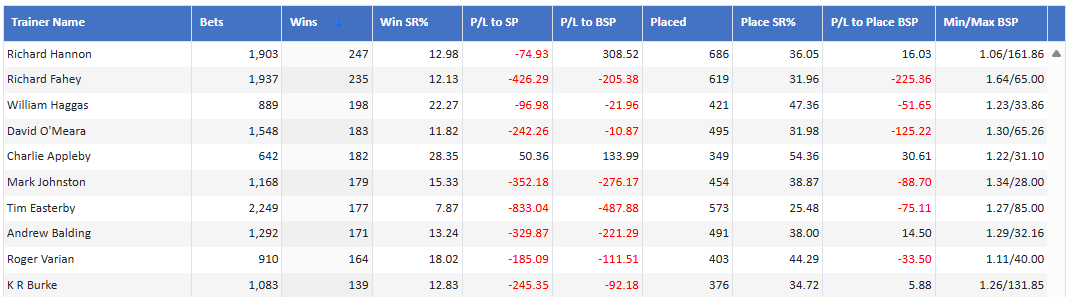
Looking at the system builder, flat racing, April and May for the last ten years. Here are the top ten trainers going by number of wins. (Click to enlarge).
What is coming up?
The season really starts to take shape over the next few weeks. The Lincoln Handicap at Doncaster has already kicked things off as the traditional curtain-raiser, a race that has been opening the turf season for well over a century and often sets the tone for what follows.
From here, things build quickly towards the spring highlights, with the Guineas at Newmarket just around the corner, followed not long after by the Derby and then Royal Ascot, which is where the season really comes into full focus.
What is interesting at this stage is that you are not always looking for the best horse on paper. You are often looking for the one that is ready to run its race today. A horse might have the strongest form in the book, but if it is having its first run in six months, there is every chance it improves for the outing. On the flip side, a less exposed horse, or one that has been running recently, can often be much sharper and more effective.
Trainers are better at getting horses ready with less runs these days, so it is worth noting the past form of how a trainer prepares his runners, especially those being aimed a big prize.
There is also a lot to be gained just from watching closely. Early-season races often throw up horses that do not necessarily win, but show enough to suggest they will be of interest next time out. The first few weeks of the turf season are full of these types, and keeping an eye on them can pay off later when the market catches up a little slower than it should.
I have been looking for horses that don't get a run when it needs one and noting when the jockey decides the horse can't win, so puts in a lot of 'false effort' by moving a lot without doing much!
One of the two I suggested on Sunday for a place, was Stanage at Doncaster. Backed into 11/2 it plugged on after it was clear the opportunity was gone, so that's one I have put into my ones to watch. With 3 previous wins from 19 runs, this looks like one that is going to win sometime this season if not more than once.
All of this means that the approach to this part of the season is slightly different. It is less about certainty and more about understanding where the unknowns are. Horses improving for the surface, runners needing their first outing, trainers targeting early races, and others just getting started for the year.
It is that mix that makes this part of the season so interesting. There is a bit more guesswork, but that also means there is more to learn, and more to take forward as the season develops and we'll soon be having 7 or 8 meetings at the heart of the summer, so at least we know the warmer weather is on the way!
If nothing else, it is a good time to start paying close attention. Because what you see over the next few weeks tends to shape everything that follows. Horses that win or have won the big heritage handicaps this year or in the past, can win them again at big odds, even when they seem to have no current form - and that's because it is how the trainer has planned it to be!
To get a new approach to your racing, take at Inform Racing and see how you're 'luck' changes.
